Vincent Sitzmann named Junior Bose Award winner
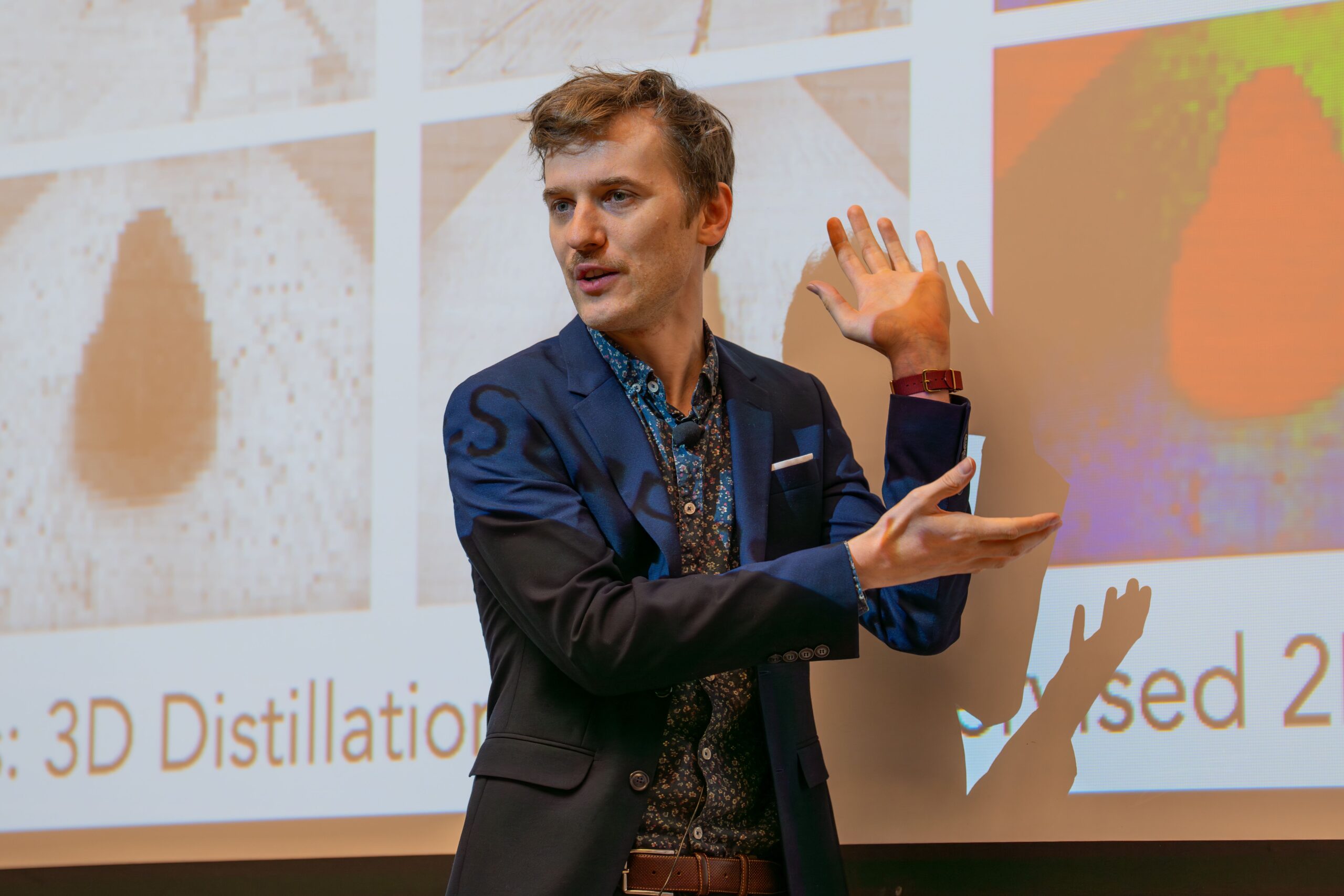
Vincent Sitzmann, the Jamieson Career Development Professor in the Department of Electrical Engineering and Computer Science (EECS), is a recipient of the 2026 Junior Bose Award. The award is given annually to an outstanding contributor to education from among the faculty members who are being proposed for promotion to associate professor without tenure.
Sitzmann received his PhD at Stanford University and his BS from the Technical University of Munich. His research goal is to build machines that learn to understand and interact with the world autonomously by building “world models” — mental simulators that enable an agent to simulate what will happen next in their environment and as a consequence of their actions, a critical piece of AI and key in downstream applications in graphics, vision, and robotics.
Sitzmann leads the Scene Representation Group at the MIT Computer Science & Artificial Intelligence Laboratory (CSAIL), where he and his team build machines that learn to understand and interact with our world autonomously.
As an instructor, Sitzmann tries to teach the class he would have wanted to take as a student.
“The courses I found most engaging were the ones that didn’t hesitate to go right up to the frontier of what we currently understand. They openly discussed things we didn’t yet understand,” he said.
He is not afraid to be honest about what is known in the field and what is still being figured out.
“Teaching at the edge of a field can feel a bit daunting, especially in areas like AI, robotics, and computer vision, where many questions are still open and the theory is still developing,” he noted. “There’s a natural pull toward topics with well-established foundations because they are often easier to present and come with a clear framework. But some of the most exciting developments today don’t yet have that kind of structure.”
He hopes his students “leave not just having learned material, but feeling inspired to contribute to the field themselves.”
Sitzmann credits several teachers and mentors with making an impact on his own approach as an educator.
“As a student, I took one of the early offerings of Convolutional Neural Networks for Computer Vision, taught by Andrej Karpathy, Justin Johnson, and Fei-Fei Li,” he said. “At the time, it was among the first deep learning-focused computer vision courses. What made it stand out to me was how it approached teaching a newly emerging research area without the benefit of well-established theoretical foundations. That balance between rigor, openness, and intellectual honesty inspired me and strongly shaped how I think about teaching.”
Sitzmann’s favorite class to teach happens to be the first one he ever taught at MIT, Machine Learning for Inverse Graphics, a seminar he built from scratch to bring students up to speed on a particular research direction in computer vision and computer graphics centered on differentiable rendering.
“It was incredibly rewarding to teach. Many of the students later told me that the class sparked a lasting fascination with 3D reconstruction and computer vision. Some shared that it played an important role in their career decisions and even came up in job interviews after they graduated. Hearing that the course had that kind of impact is about the best feedback I could hope for,” Sitzmann said.
Even with positive student feedback, Sitzmann still finds himself questioning whether his assumptions about what makes a class valuable to students are the right ones. He noted that receiving this year’s Junior Bose award feels like “a vote of confidence from my colleagues, and I’m very grateful for that support.” “I am immensely honored to receive this award,” he said. “I put a great deal of effort into developing two courses at MIT, launching my seminar and redesigning the graduate-level computer vision class, and I worked hard to turn them into classes I would be excited to take as a student.”