NAE Regional Meeting at MIT Explores Creativity in an AI-Enabled World
Centered on the theme “Think Differently: Understanding and Leveraging Creativity in an AI-Enabled World,” the program explored how human ingenuity continues to drive innovation across disciplines.
The National Academy of Engineering (NAE) convened members and invited experts at the Massachusetts Institute of Technology (MIT) for a regional meeting on creativity in the age of artificial intelligence. Centered on the theme “Think Differently: Understanding and Leveraging Creativity in an AI-Enabled World,” the program explored how human ingenuity continues to drive innovation across disciplines.
Opening remarks from MIT School of Engineering Dean Paula T. Hammond, co-chair MIT Professor Markus Buehler, and NAE President Dr. Tsu-Jae Liu set the stage for a day of discussions on the role of creativity in addressing complex global challenges.


The symposium opened with a keynote from Yann LeCun, who explored how intelligence and creativity can be modeled and understood in both humans and machines. His remarks framed the broader conversation around the limits of current AI systems and the enduring importance of human-driven insight.
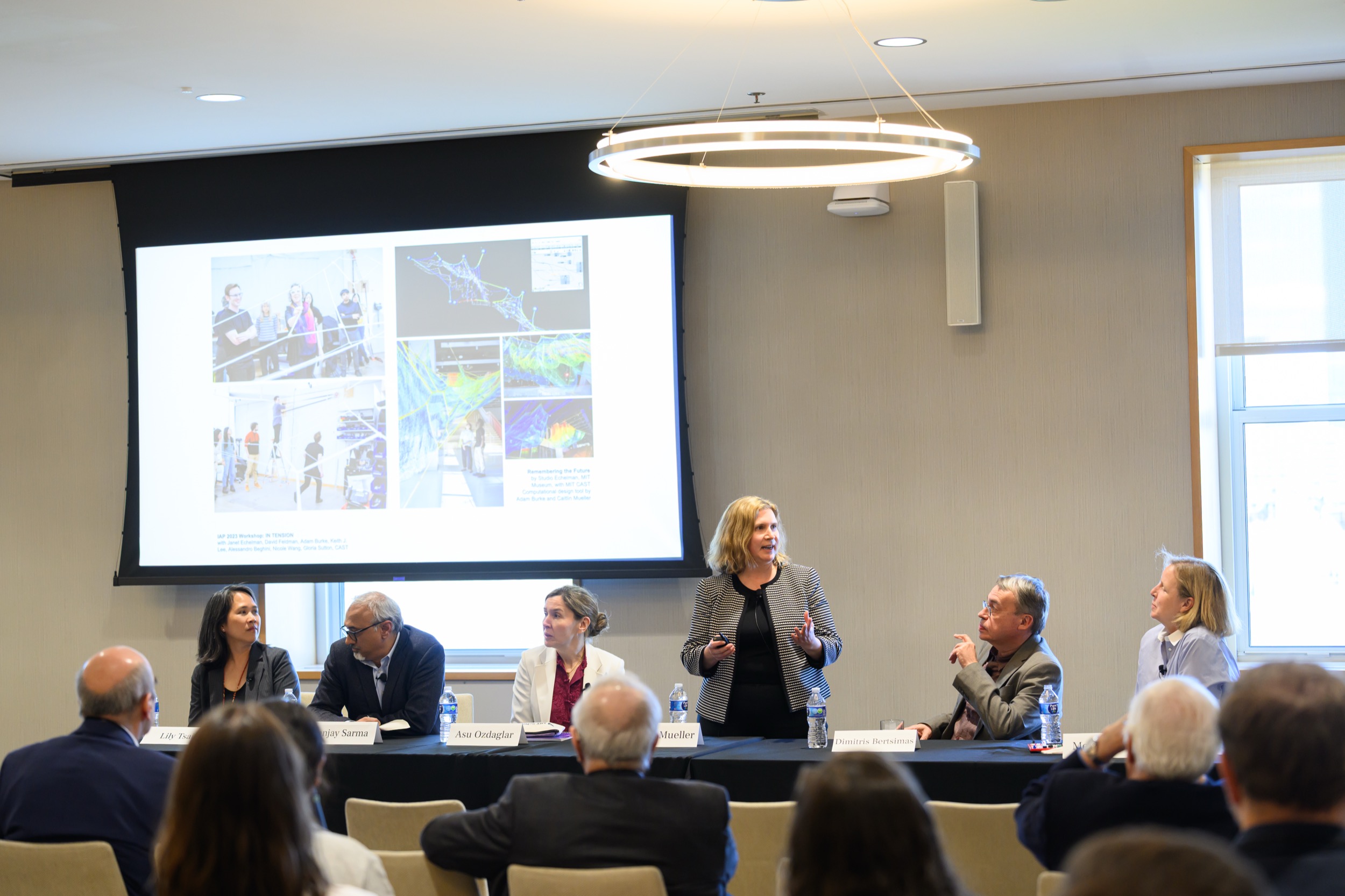
Speakers and panelists throughout the day examined creativity from multiple perspectives. The first session focused on how the brain generates creative ideas and how these processes can inform advances in artificial intelligence. The second session began with a keynote by Angela Belcher, James Mason Crafts Professor in the Departments of Biological Engineering and Materials Science and Engineering at MIT, who spoke about the work she does evolving biology to make new materials for energy, the environment, and medicine. Speakers in the second session then highlighted the power of interdisciplinary collaboration, with speakers sharing examples from fields including energy, climate, robotics, and materials science. A third and final session turned to education. In a panel moderated by Megan J. Smith, third US Chief Technology Officer, panelists explored how institutions can better prepare students to think beyond traditional boundaries and solve complex problems in new ways.
Across sessions, speakers emphasized that while AI offers powerful tools, transformative breakthroughs still depend on human creativity, collaboration, and the ability to connect ideas across disciplines.
The program concluded with closing remarks from MIT Provost Anantha P. Chandrakasan and a reception that provided opportunities for continued conversation and exchange among participants.
Together, the discussions highlighted the essential role of creative thinking in advancing engineering and underscored the importance of preparing the next generation to innovate in an increasingly AI-enabled world.