Read Dean Hammond’s Commencement Speech
Wednesday, May 27, 2026 — School of Engineering & Schwarzman College of Computing Advanced Degree Ceremony
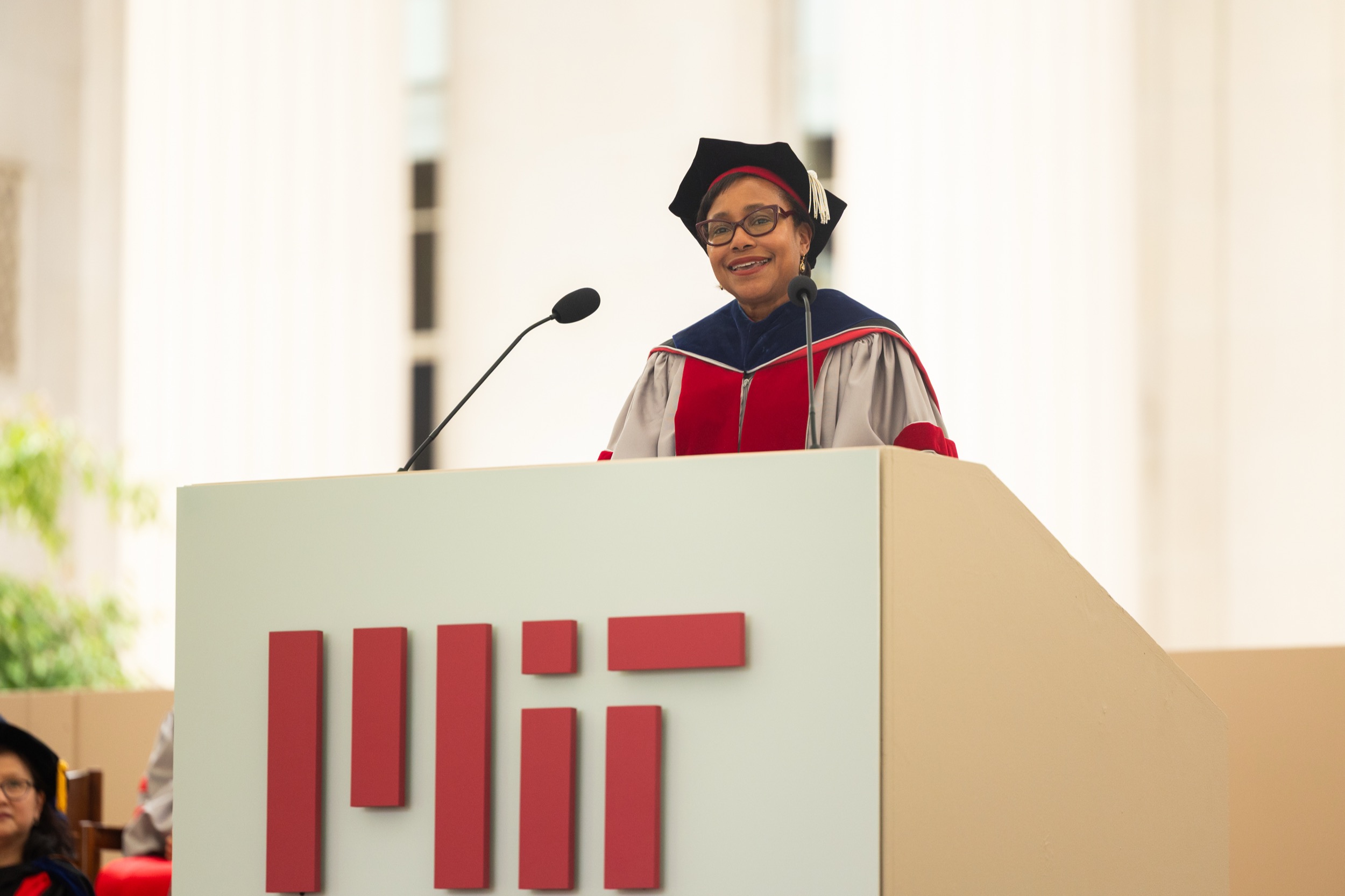
Good afternoon! I’m Paula Hammond, Dean of the MIT School of Engineering. It is an honor to greet you this morning for my first time as Dean of Engineering – and to welcome you to the 2026 MIT School of Engineering and Stephen A. Schwarzman College of Computing Advanced Degree Ceremony!
I think everyone gathered here today, in front of this iconic dome, can agree on one thing: MIT is a special place. MIT is often defined by paradigm-shifting breakthroughs, by invention, innovation and interdisciplinary discovery. By the technology that takes shape in our labs and the ideas that find their way from our classrooms to the broader world.
But what makes MIT special isn’t just what happens underneath this dome – it’s special because of you, members of the Class of 2026.
Take a moment to reflect on the personal qualities that make you special – those very qualities that likely brought you to this campus.
Watch Dean Hammond’s Commencement Speech
Your deep passion for making a difference. Your brilliant accomplishments. Your willingness to dig in and learn. Your eagerness to get to the lab and experiment, or roll up your sleeves and go out to the field, or to wrestle with, and ultimately untangle, complex algorithms or problem sets. Your desire to learn from the masters and the top research groups in your field. All of these qualities brought you to MIT, and to this day.
Now, think about the moment you arrived at MIT to start your graduate program.
Whether it was your first time stepping foot on campus, or you had already spent years here navigating our many numbered buildings, you still felt that sense of anticipation – and maybe a few butterflies – wondering what this next challenge would demand of you. That is something I experienced myself. I can distinctly remember when I returned to MIT, where I had received my bachelor’s degree, to begin my doctoral studies.
After graduating with my bachelor’s degree in chemical engineering from MIT, I spent four years in the workforce. First at Motorola, then at Georgia Tech Research Institute, where I worked while completing my master’s degree part-time. When I returned to MIT’s campus to start my doctoral studies, mixed in with the excitement, I had a true sense of fear. I wasn’t sure that I could hack it again as a full-time student. I had stepped away from my career to pursue this degree. I couldn’t help but wonder if I had made the right decision. And I was so different in many ways from my classmates, including the fact that unlike many of the peers in my program, I was married, and I had spent time away from intensive classroom studies – so I wondered “Do I belong here?”
As a graduate student at MIT, I learned quickly things often don’t go as planned. Sometimes, the journey shifts in ways you don’t expect. My own path during graduate school was anything but linear. Early on, I remember trying to synthesize a polymer that had to have a certain set of properties, and I just couldn’t get it made. The chemistry wasn’t coming together. I had to alter course, and focus on previously designed materials just to get my project started.
And then, right in the middle of graduate school after my third year, I embarked on an entirely different kind of journey. I was pregnant and faced balancing my doctoral studies with motherhood. A clear path to completing my thesis still evaded me, and I was about to welcome a child. I couldn’t help but wonder how this would all work out. And again I asked myself, Do I belong here – right now? Or more importantly, is this even going to work out?
For me, my fellow grad students, including the ones in my program who went through qualifying exams, thesis proposals and experimental setbacks alongside me became my true support mechanism. We came from different backgrounds and entered graduate school at different stages of life, but we buoyed and uplifted one another.
The fall after I gave birth, I made a big and risky decision to drop that original polymer I was trying to make and make a new family of polymers that was not a part of my original thesis proposal. And those systems worked! That experience of adjusting my path while holding on to my long-term vision landed me at my own doctoral hooding ceremony in 1993, with my family – including my two year old child waving at me from the stands.
So – when I look out onto the crowd today, I imagine that, like me, many of you may have wrestled with similar feelings – what we often call “imposter syndrome.” Others among you may have started with a sense of confidence but found unexpected obstacles along the path which made you wonder about the possibility of crossing the finish line (and crossing fully intact!).
But in those moments, something important happened. You found each other. You built community. You leaned on lab mates, classmates, mentors, and friends – and they leaned on you. That, too, is a part of what makes MIT special. Not just the breakthroughs, but the community that supports each other every step of the way.
Each of you has taken your own journey to get to this day. And along the way you have been transformed – shaped by your experiences and the people around you. That journey has included triumphs: that first author paper, presenting at a major conference, watching a prototype finally work after months of trial and error, completing hours of rigorous coursework and reaching that moment in class – or in the field – where it all made sense.
But as with any meaningful journey, there have also been challenges. Experiments that failed. Papers rejected by your dream journal. Fellowship or funding opportunities that didn’t come through. Moments when you questioned yourself, and, like me, wondered: “Do I belong here?” or, “Will this even work?”
Wherever your journey leads you once you cross this stage today, I want you to remember it is you that makes MIT special. And as you start this next chapter in your lives, when you start to feel that doubt and imposter syndrome creep back in, let me remind you:
It was you who defended that thesis.
It was you who took those challenging courses.
It was you who launched that startup.
It was you who secured that fellowship.
It was you who mentored undergraduates in the lab and in the classroom.
It was you who showed up for your peers when they needed support.
It was you who kept going, even when it would have been easier to stop.
It has always been you – and the qualities that you brought here – that make MIT what it is.
Those same qualities brought you to this moment, dressed in full regalia, marking the culmination of one journey and the beginning of another. They guided you to your field of study. They sparked new ideas through collaboration with your peers and mentors. They helped you discover new questions and new passions along the way. And they will continue to guide you in what comes next.
Take those qualities with you:
That tenacity.
That boundless curiosity.
That drive to imagine and to make a difference.
That instinct to support others.
That ability to solve complex problems.
That creativity and collaborative spirit.
You came to MIT and made it more special – contributed to it in your own unique way. Now as you go out into the world, you bring a piece of MIT with you. But more importantly, the world gets to have you. All those qualities you bring that made MIT special are now headed out into communities, industries, and fields that need exactly what you have to offer. And as you go out into the world, stay open to where your path may lead. When you follow your curiosity and your passion, you may find yourself somewhere you never expected.