Over the past 160+ years, MIT engineers have been at the forefront of discovery and innovation, pioneering technologies that have shaped our modern world and advanced the nation’s economy.
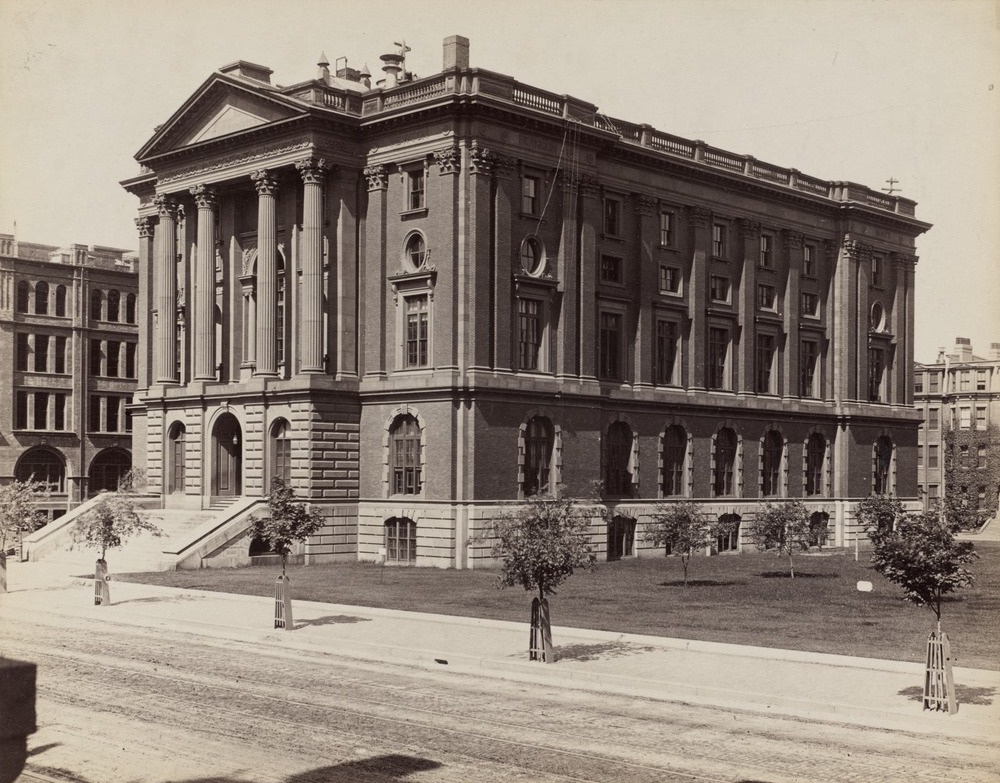
From the very beginning in 1861, MIT’s education blended a firm grounding in science with practical training in engineering – a revolutionary approach in the 19th century. Across generations, MIT engineers have defined pivotal moments in history. They developed radar at the Radiation Laboratory during World War II, created the guidance and computing systems that carried Apollo astronauts to the Moon, and helped lay the foundations of today’s internet through early time-sharing and networking innovations. Along the way, the School of Engineering helped launch entirely new fields — including electrical, aeronautical, chemical, and biological engineering — and advanced transformative research across disciplines.
Today, the School of Engineering remains MIT’s largest academic unit, home to eight departments, two Institutes, and a vibrant ecosystem of interdisciplinary centers, labs, and programs. As the School continues to evolve, its focus remains clear: advance bold ideas, educate the next generation of engineering leaders, and deliver innovations that strengthen the nation and improve the world — just as it has done since the Institute’s founding.
Timeline
Founding and Early Years (1861-1910)
1861 – MIT founded
The Massachusetts Institute of Technology is chartered by the Commonwealth of Massachusetts on April 10, 1861, spearheaded by William Barton Rogers’s vision of a polytechnic institute devoted to science and engineering.
1865 – First classes and engineering courses
MIT opens its doors in Boston and admits its first students. The initial curriculum includes mechanical construction and engineering, civil and topographical engineering, and practical geology and mining.
1882 – First electrical engineering curriculum
Professor Charles R. Cross establishes the country’s first electrical engineering program at MIT.
1883 – Department of Mechanical Engineering founded
MIT creates the Department of Mechanical Engineering (Course II) as a distinct unit, specializing in naval architecture, marine, locomotive, and mill engineering.
1884 – Department of Mining/Metallurgy (now DMSE) founded
MIT establishes a Department of Mining and Metallurgy (Course III), which would later evolve into today’s Department of Materials Science and Engineering, reflecting the Institute’s early involvement in mining engineering, metallurgy, and materials processing.
1888 – First chemical engineering program
Professor Lewis Mills Norton establishes a program in chemical engineering within the Department of Chemistry.
Reorganization and Growth (1910-1939)
1902 – MIT Department of Electrical Engineering founded
MIT establishes the Department of Electrical Engineering (Course 6) – later renamed the Department of Electrical Engineering and Computer Science.
1914 – First aeronautical engineering course
Anticipating the age of flight, MIT offers the nation’s first course in aeronautical engineering. Professor Jerome C. Hunsaker and colleagues establish a wind tunnel and curriculum for aeronautics under Course II, laying the foundation for aerospace education in America.
1916 – MIT moves to Cambridge
MIT relocates from Boston to a new campus in Cambridge, Massachusetts. The move provides expanded space, including large labs and the iconic Great Dome, enabling growth in engineering research and education.
1916 – School of Chemical Engineering Practice founded
The School of Chemical Engineering Practice is founded for students to experience applied learning at chemical plants.
1920 – Department of Chemical Engineering Founded
MIT’s Course X, the Department of Chemical Engineering, splits from the Department of Chemistry and is formally organized as its own department. It starts graduating engineers for the burgeoning petrochemical and pharmaceutical industries.
1931 – Computing at MIT
Vannevar Bush creates the differential analyzer, a mechanical analog device that is one of the earliest examples of computing at MIT.
1932 – MIT School of Engineering founded
MIT undergoes an academic reorganization and formally establishes the School of Engineering in 1932 as one of its principal schools. Dean Vannevar Bush is appointed to lead the new School, which initially includes Departments of Civil Engineering, Mechanical Engineering, Electrical Engineering, Mining & Metallurgy, Naval Architecture & Marine Engineering, and an “Engineering Administration” program.
1938 – Wright Brothers Wind Tunnel dedicated
The Wright Brothers Wind Tunnel was dedicated on September 12, 1938, at the 5th International Congress of Applied Mechanics.
1939 – Department of Aeronautics founded
Building on decades of aviation work, MIT elevates aeronautical engineering to full departmental status. The Department of Aeronautics (Course 16) is founded (later renamed the Department of Aeronautics and Astronautics), solidifying MIT’s role in educating aerospace engineers just as World War II begins.
World War II and Global Impact (1940-1959)
1940 – Radiation Laboratory established
MIT opens the secret Radiation Laboratory or “Rad Lab” in fall 1940 to develop microwave radar technology for WWII. Over the next five years, the Rad Lab’s researchers greatly advance radar systems, contributing directly to the Allied war effort and laying the groundwork for the postwar electronics industry.
1944 – Flight simulator
Project Whirlwind is initiated to develop a computer-aided flight simulator for the U.S. Navy. The end result is the first large-scale high-speed, digital computer.
1944 – Aircraft Radar System
MIT and the Naval Research Lab in Washington DC begin Project Cadillac, an early-warning radar system for aircraft.
1946 – Research Laboratory for Electronics founded
The Research Laboratory for Electronics is founded as the successor to the Rad Lab.
1951 – MIT Lincoln Laboratory founded
MIT establishes Lincoln Laboratory in 1951 as a federal research center to build the nation’s first modern air defense system. Lincoln Lab’s work profoundly influences both national security and civilian technologies.
1958 – Department of Nuclear Engineering founded
The Department of Nuclear Engineering is established, focusing on nuclear reactor technology and addressing the Cold War “technology gap” in science and engineering education. That same year MITR-1, MIT’s nuclear reactor, becomes operational.
1959 – MIT Artificial Intelligence Group founded
The first coordinated AI research at MIT began when John McCarthy and Marvin Minsky founded the Artificial Intelligence Group as part of both the Research Laboratory for Electronics (RLE) in Building 26 and the Computation Center.
The Space Age and Digital Revolution (1960-1989)
1961 – Apollo Program contract
On August 10, 1961, MIT’s Charles Stark Draper Lab (Instrumentation Lab) receives NASA’s first contract of the Apollo Program. MIT is tasked with designing the Apollo Guidance Computer and navigation system, marking the beginning of MIT’s pivotal involvement in the effort to land humans on the Moon.
1963 – Launch of Project MAC
With DARPA support, the MIT Project on Mathematics and Computation (Project MAC) is launched to investigate artificial intelligence, computational theory, and operating systems
1967 – Reading Machine for the Blind
Research Laboratory for Electronics creates a reading machine for the blind, the world’s first affordable optical character reader.
1968 – Joint WHOI Program established
A joint program in oceanography and ocean engineering with the Woods Hole Oceanographic Institute is announced by what is then Course 13, the Department of Ocean Engineering.
1969 – Apollo 11 Moon landing
On July 20, 1969, Apollo 11 lands on the Moon. The spacecraft is guided by the MIT-designed Apollo Guidance Computer and inertial guidance, and MIT alumnus Buzz Aldrin walks on the lunar surface. This achievement highlights the School of Engineering’s role in one of humanity’s greatest explorations.
1970 – MIT-Havard Program in Health Sciences and Technology (HST) founded
The MIT-Harvard Program in Health Sciences and Technology (HST) is founded, reflecting a trend of integrating engineering with medicine.
1973 – Center for Transportation Studies founded
The Center for Transportation studies is founded and later renamed the Center for Transportation and Logistics (CTL).
1975 – Department of Mining/Metallurgy Renamed
The Department of Mining/Metallurgy is renamed as the Department of Materials Science and Engineering (Course 3)
1975 – Electrical Engineering Department Renamed
The Department of Electrical Engineering is renamed as the Department of Electrical Engineering and Computer Science (Course 6).
1977 – Laboratory for Manufacturing and Productivity established
The Laboratory for Manufacturing and Productivity (LMP) is an interdisciplinary organization of faculty and students that develops and applies fundamental principles of manufacturing processes, machines, and systems.
1977 – Invention of RSA encryption
MIT researchers Ronald Rivest, Adi Shamir, and Leonard Adleman invent the RSA public-key cryptography algorithm, which becomes a cornerstone of Internet security, enabling secure online communications and commerce in the digital age.
1978 – Laboratory for Information and Decision Systems established
Information theorists from the Research Laboratory for Electronics join the Electronic Systems Laboratory to form the Laboratory for Information and Decision Systems (LIDS)
1980 – Materials Processing Center founded
The Materials Processing Center was established in response to a need to make American industry more competitive and bring the focus back to civilian industry as the Cold War was winding down.
1984 – Microsystems Technology Laboratories founded
The Microsystems Technology Laboratories is launched. Its initial set of labs included the Integrated Circuits Laboratory, Technology Research Laboratory, and Submicron Structures Laboratory.
1988 – Leaders for Manufacturing (later Leaders for Global Operations) founded
The Leaders for Manufacturing Program is founded at a time when Japan and other overseas rivals were challenging U.S. manufacturing dominance in areas including the automotive industry. The program was later renamed the Leaders for Global Operations (LGO).
Modern Era and Future Outlook (1990-Present)
1992 – Course 1 renamed the Department of Civil and Environmental Engineering
Civil Engineering (Couse 1), is renamed the Department of Civil and Environmental Engineering, reflecting civil engineers’ impact and responsibility for the environment that they help shape.
1994 – Founding of the World Wide Web Consortium
MIT hosts the launch of the World Wide Web Consortium (W3C), led by Web inventor Tim Berners-Lee.
1994 – Lemelson-MIT Program established
Founded by a gift from the Lemelson Foundation and administered by the School of Engineering, the Lemelson-MIT Program aims to inspire young people to become inventors and entrepreneurs by providing invention education opportunities.
1996 – Systems Design and Management Program established
The School of Engineering and Sloan School of Management launches the Systems Design and Management Program (SDM), an innovative graduate degree program that combines advanced engineering and management skills.
1998 – Department of Biological Engineering founded
MIT formally establishes the Department of Biological Engineering (Course 20). The first new MIT engineering academic department in decades. This milestone integrates molecular biology with engineering principles, leading MIT’s efforts in biotech, bioinformatics, and biomedical engineering as critical fields of the 21st century.
2002 – Deshpande Center for Technological Innovation founded
Through a generous gift from Jaishree Deshpande and Desh Deshpande, the Deshpande Center for Technological Innovation dedicated to helping MIT researchers bring their innovative technologies to the marketplace in the form of breakthrough products and new companies.
2003 – MIT Computer Science and Artificial Intelligence Laboratory established
The Laboratory for Computer Science and the Artificial Intelligence Laboratory merge to form the MIT Computer Science and Artificial Intelligence Laboratory (CSAIL).
2003 – MIT OpenCourseWare launches
By the early 2000s, MIT’s School of Engineering takes a lead in open education. MIT OpenCourseWare makes the Institute’s engineering course materials freely available online worldwide.
2005 – Department of Ocean Engineering joins Department of Mechanical Engineering
Course 13 – the Department of Ocean Engineering – joins Course 2, the Department of Mechanical Engineering. Marine-oriented research continues via the Center for Ocean Engineering.
2007 – Gordon-MIT Engineering Leadership Program launched
Launched through a gift from the Gordon Foundation, Bernard M. Gordon-MIT Engineering Leadership Program (GEL) is established to educate and develop the character of outstanding MIT students as potential future leaders in the world of engineering
2011 – MIT celebrates its 150th anniversary
MIT celebrates its 150th anniversary
2019 – Schwarzman College of Computing founded
MIT announces the creation of the Stephen A. Schwarzman College of Computing in, a historic expansion to accelerate computing research and education across all disciplines. The Department of Electrical Engineering & Computer Science (Course 6) is reorganized to be jointly administered by the new college and the School of Engineering, reflecting the increasingly interdisciplinary nature of computing and engineering.
2021 – MIT Climate and Sustainability Consortium established
MIT Climate & Sustainability Consortium (MCSC) is an academia-industry collaboration to help meet global climate and sustainability challenges.
2022 – Daniel J. Riccio Graduate Engineering Leadership Program founded
Daniel J. Riccio, made a gift of $10 million to expand MIT’s Graduate Engineering Leadership Program which was renamed the Daniel J. Riccio Graduate Engineering Leadership Program (GradEL).
2025 – Cross-Institute initiatives
Several interdisciplinary initiatives in key priority areas launched by Dean of Engineering Anantha Chandrakasan to foster interdisciplinary research in strategic priority areas, including: the MIT Health and Life Sciences Collaborative, the MIT Human Insight Collaborative, the MIT Generative AI Impact Consortium, the MIT Initiative for New Manufacturing and the MIT Quantum Initiative.
Deans of Engineering
- Vannevar Bush – Dean from 1932 to 1938
- Edward L. Moreland – Dean from 1938 to 1946
- Thomas K. Sherwood – Dean from 1946 to 1952
- Edward L. Cochrane – Dean from 1952 to 1954
- Carl R. Soderberg – Dean from 1954 to 1959
- Gordon S. Brown – Dean from 1959 to 1968
- Raymond L. Bisplinghoff – Dean from 1968 to 1971
- Alfred H. Keil – Dean from 1971 to 1977
- James D. Bruce – Acting Dean from 1977 to 1978
- Robert C. Seamans, Jr. – Dean from 1978 to 1981
- Gerald L. Wilson – Dean from 1981 to 1991
- Joel Moses – Dean from 1991 to 1995
- Robert A. Brown – Dean from 1996 to 1999
- Thomas L. Magnanti – Dean from 1999 to 2007
- Subra Suresh – Dean from 2007 to 2010
- Cynthia Barnhart – Acting Dean from 2010 to 2011
- Ian A. Waitz – Dean from 2011 to 2017
- Anantha P. Chandrakasan – Dean from 2017 to 2025
- Maria C. Yang – Interim Dean from 2025 to 2026
- Paula T. Hammond – Dean from 2026 to present